
An “unbiased” approach ?
Old Testament Use of Old Testament [6]

Second Tuesday Feature
In my excitement over the release of OTUOTPL (Old Testament Use of Old Testament in Parallel Layout) this fall, Carpenter’s Student is counting down the top ten moments of the sister project OTUOT (Old Testament Use of Old Testament).
Number 6: “Unbiased” approach?
Hard to tell
Sometimes you can’t tell when someone is kidding. An anonymous someone sent me a surprise gift of a new flavor of coffee. It has dark chocolate overtones and plum and nectarine undertones. I’m sure a student sent it to me to try the flavor, right? It’s great!

My good friend is working on a book idea that he shared with students during exam week. It’s gonna’ be a hit I think.

The question . . .
In a podcast interview with OnScript, the host, Dr. Matthew Lynch asked me a question that caught me off-guard. He asked me to the effect:
“Is it unbiased to approach the use of scripture according to the books of the Old Testament?”
He asked this because OTUOT takes a book-by-book approach through Israel’s scriptures. I’ll come back to my answer, as I remember it, but some context about the question first.
In OTUOT (xl) I lay out four models for interpreting the Bible’s use of the Bible.
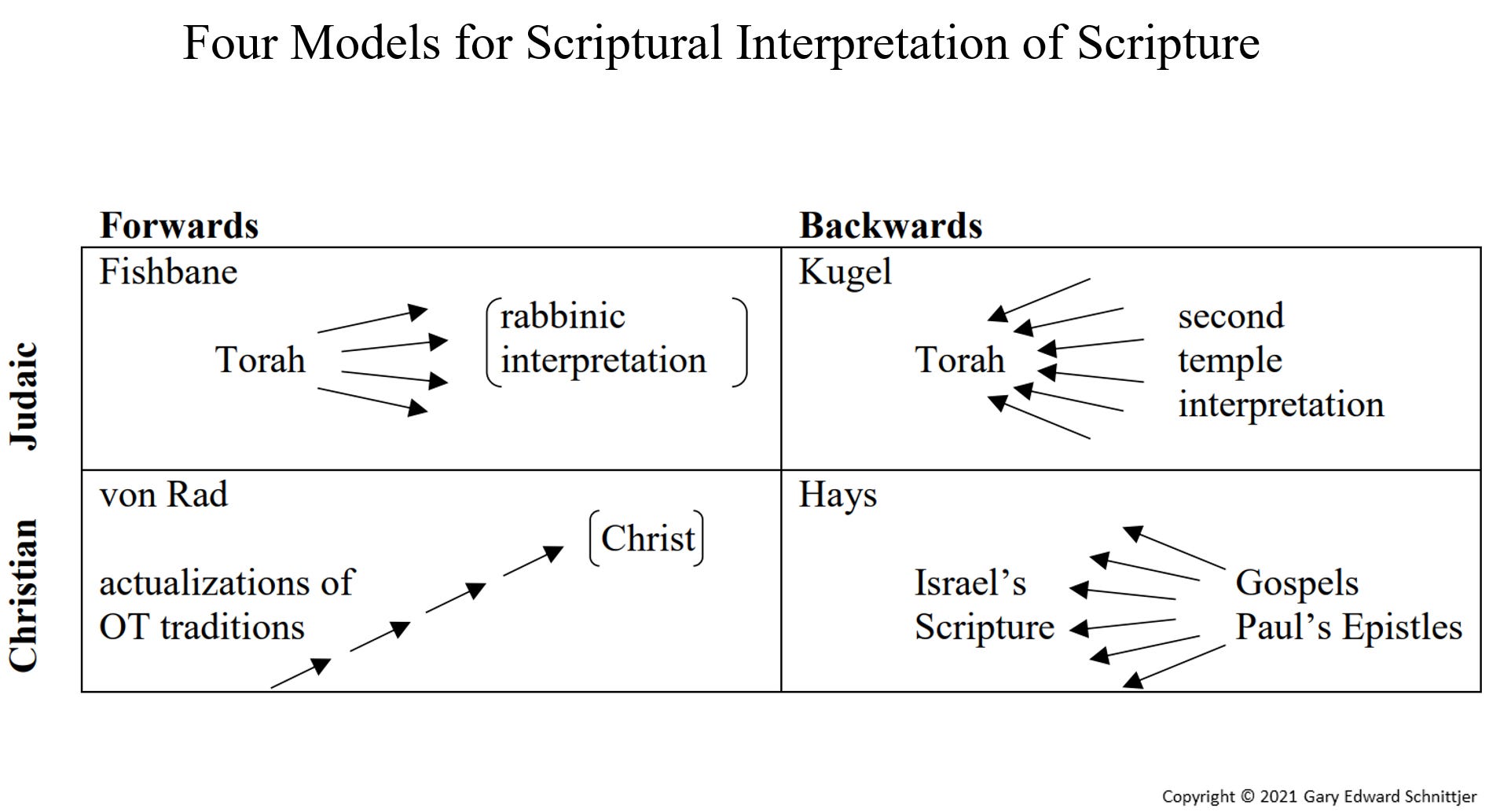
Gerhard von Rad and Michael Fishbane both read forward. Von Rad traces out innovations at each stage of the theoretical historical-critical reconstruction of the gradual development of Old Testament literature as he sees it. He views redemption moving forward toward the gospel.
Fishbane organizes his research around exegesis within Israel’s scriptures that is akin to traditional rabbinic exegesis, especially legal and narrative interpretive tendencies. This organization helps him demonstrate the origins of the Jewish exegetical tradition as emerging from within the scriptures themselves.
I make the case that:
“there is no need to wink and ‘objectively’ trace the emerging biblical interpretive traditions to their predetermined rabbinic or Christian ends” (OTUOT, xl).
The point here is not to find fault with the approaches of either von Rad or Fishbane—their bodies of research on exegesis within scripture are immensely important—but to observe that they specifically decided not to study exegesis in the Hebrew scriptures book by book. These scholars knew what they would find before they even opened the Bible to do their research.
This is part of the reason I prefer to admit that reading forward is not step one but step two. The starting point is “retrospective prospectivity” (xl). It’s a mouthful, I know. A more normal way to frame it is “reading the Hebrew Bible as Christian Scripture” (xli).
A scroll-by-scroll approach in OTUOT
Here’s a more technical answer to Matt’s question than I gave him during the podcast interview.
The liabilities and benefits of a scroll-by-scroll approach to investigating exegetical advancements within Israel’s scriptures include giving the biblical authors the last word. This approach is not a way to use exegesis within scripture to take apart theoretical editorial layers to reconstruct theoretical sources that need to be placed in theoretical life settings and their accompanying theoretical scribal cultures. To take a book-by-book approach turns the focus onto exegetical outcomes within the writings that the biblical authors have put together.
Approaching exegesis within the books of the Bible transcends this or that sectarian agenda as well as the lines between competing theological systems. Christian interpreters come to the books of the Bible because that is the way it pleased God to gift revelation to his people.
By organizing the evaluation of exegetical advances within Israel’s scriptures scroll by scroll the larger advancements of revelation come into view. Read this way revelation advances, but not in a single straight line or evenly or at the same pace. Not at all. A book-by-book approach shines a bright light on the messy path of Yahweh’s wayward people.
A book-by-book approach to evaluating scriptural exegesis accents the individual interpretive approaches of the biblical authors. But the cumulative results are not a positive celebration of interpretive diversity or a negative display of exegetical mayhem.
A book-by-book approach to evaluating scriptural exegesis uncovers a deep coherence between the exegetical programs of the authors of Israel’s scriptures. Part of this can be explained by the honor they give to the same donor texts in Torah. The entire idea of looking back to what God has already said to make sense of present crises or future hopes begins to explain the natural continuity within the varieties of exegetical advances across Israel’s scriptures.
Coherence of exegetical advancements across the extremely diverse set of biblical scrolls with their distinctive hermeneutical tendencies comes easy. Why? Because of a shared outlook born and sustained by careful study of the same earlier scriptural revelation. There is no reason to be surprised by the continuity of progressive revelation. Exegetical advancements naturally breed kindred exegetical advancements.
Did you really say all that in a podcast interview?
No, probably not. When Matt asked me, as I said above (I’m paraphrasing):
“Is it unbiased to approach the use of scripture according to the books of the Old Testament?”

I think I said to the effect: No. Studying the use of earlier scripture in each book of the Bible is merely a different bias. Part of the reason this bias works is that’s how the Bible’s shaped. Everywhere we go the Bible is shaped by its books. (Hopefully, I have remembered the gist of the really fun conversation I had with Matt. But if I distorted things, hopefully someone can clear it up in the comments section.)
Here’s an example of what I mean. The prophet Isaiah always begins by remixing the famed opening of the song on Moses.
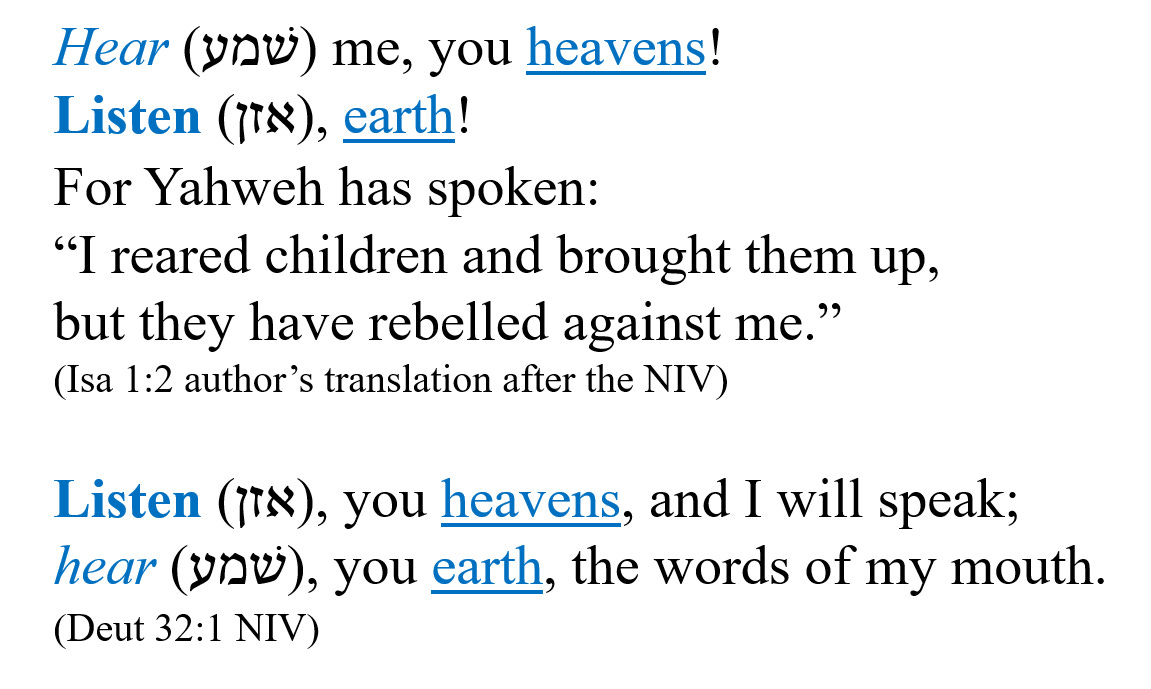
Consider the likely trace. A trace is an unquoted passage that gives rise to the biblical author’s interpretation. We always need to be careful with traces because of the absence of explicit evidence. Moses may have in mind witnesses for the covenant agreement. The trace is Isaiah’s seeing the heavens and the earth as the two or three witnesses needed in the capital case against Yahweh’s own son Israel (cf. Deut 21:15‒17). “Upon the testimony of two witnesses or three witnesses shall a person surely be put to death” (author’s translation). Look again at Isaiah 1:2 above and see what you think.
What could be more compelling than the song of Moses that leads and vision of Isaiah that follows in these two moments of Yahweh’s revelation. We come to these with the scrolls of Israel’s scriptures in our Bible. A book-by-book approach enhances how we need to appropriate these teachings.
Please check out the OnScript interview about Old Testament Use of Old Testament.
Audio version of OnScript
Want more?
When researching OTUOT, I found something new. Typically, I view any new interpretations I come up with as mistaken. But this one wouldn’t let me go. Here’s an invited presentation for the first meeting of the Scriptural Use of Scripture section of ETS (Evangelical Theological Society)—provided free by permission of the Journal for the Study of the Old Testament entitled “Going Vertical with Love Thy Neighbor.”
Here’s a fun series of five “Surprises of Old Testament Use of Old Testament” that I was invited to share on the Creedo Magazine blog: Surprise 1, Surprise 2, Surprise 3, Surprise 4, Surprise 5.
If you don’t have a copy, check it out.

See the other installments of the top ten moments of OTUOT here.
Coming up . . .
The next Second Tuesday Feature is about an index. (An index?! Seriously?) Yes, an index. (I fell asleep when you said “index.”) Wait and see. Indexes can be fun (Try again.) gripping (Get outta here) compelling (C’mon man!) . . . worth it. You’ll see.
Cairn University
Our priority: Christ and his word.

Hi Gary! Thanks for this. What you call bias I might call perspective, but I find it interesting and enjoyed reading the post. Might even buy the book. :-)