
Eleven Days that Changed Bible Study for Good
Connected

Second-Tuesday Feature
Connected is Coming!
Over the past year, Carpenter’s Student has twice engaged the narrative of Scripture study in Nehemiah 8. Once to see how the people’s Bible study failed (here) and once to emphasize five reasons to study the Bible that come right out of this event (here).
We need to return to the amazing Scripture study in Nehemiah 8 to investigate what it teaches us about how to study the Bible for ourselves. This passage is the centerpiece of Chapter 4 “Welcome to Studying the Bible” in my new book Connected: How Scripture Guides the Study of Scripture. No passage in the Bible offers a richer resource on Bible study than this one.
When did they study the Bible?
Several weeks after they finished rebuilding the walls of Jerusalem, the people get Ezra to read Torah to them. One day wasn’t enough.
Eleven days in the seventh month . . .
first day (Neh 8:2)
second day (8:13)
fifteenth through the twenty-second days during Tabernacles (8:18)
twenty-fourth day (9:1)
How did they study the Bible?
They made connections. We know they made connections and what kinds of connections they made because the Bible explains the outcomes of their Bible study.
In Nehemiah 8, the postexilic congregation reconnected participation of ordinary believers to celebrate the Feast of Tabernacles. The people learn from the Bible that they are to participate in something of a living parable, by making and dwelling in temporary huts from leafy branches. In this way the people worship Yahweh by celebrating the redemption of his people.
In Nehemiah 9, the congregation prays. The Levitical intercessors lead the people in a sweeping biblical retrospective that connects together the entire storyline of Yahweh’s redemption from the pages in the scrolls of scripture. This is the longest panoramic historical retrospective anywhere in the Bible. This means the people studied the scriptures to learn who they are, why they are here, and what it means to serve God. The confess their sin and they confess that Yahweh is righteous. They connect together the redemptive story that they see in the Bible and pray it back to Yahweh.
The people don’t ask for anything specific. Can you imagine?! All that Bible study and all that prayer and then no ask.
Think about the kind of faith they learn from the redemptive narrative in scripture. They place themselves in the redemptive storyline and then ask Yahweh to see them. That is, they leave it up to God to look at them and to decide what they need. They trust in the God of the Bible, even without an ask.
How often have you done that?
See, we today are slaves. In the land that you gave to our ancestors to eat its fruit and its goodness, see, we are slaves upon it. (Neh 9:36 translation mine)
In Nehemiah 10, the people make life connections based on their place within the redemptive storyline they had laid out in the previous chapter. They commit themselves to obey scripture, which, at first, seems to align with Ezra himself (7:10).
But the postexilic community does something bold. They don’t merely commit to compliance. They promise to obey above the level of what the Bible teaches. Incredible. There’s nothing like this elsewhere in the Bible.
In sum, the early Second Temple congregation in Nehemiah 8‒10 shows us how to study the Bible by its connections.
Connecting Scripture
Nothing is better than the Bible to teach us how to study the Bible. That’s what Connected is about. Chapter 4 zeros in on the first day of scripture study in Nehemiah 8:1‒8 to see what it tells us about Bible study. The postexilic congregation makes context connections that include both literary frames (word, sentence, paragraph, unit, book, the Israel story, and the gospel story of the entire Bible) and literary devices. Connected digs into both of these. Here’s an overview of some of the literary connections that shape the narrative of the first day of Bible study.
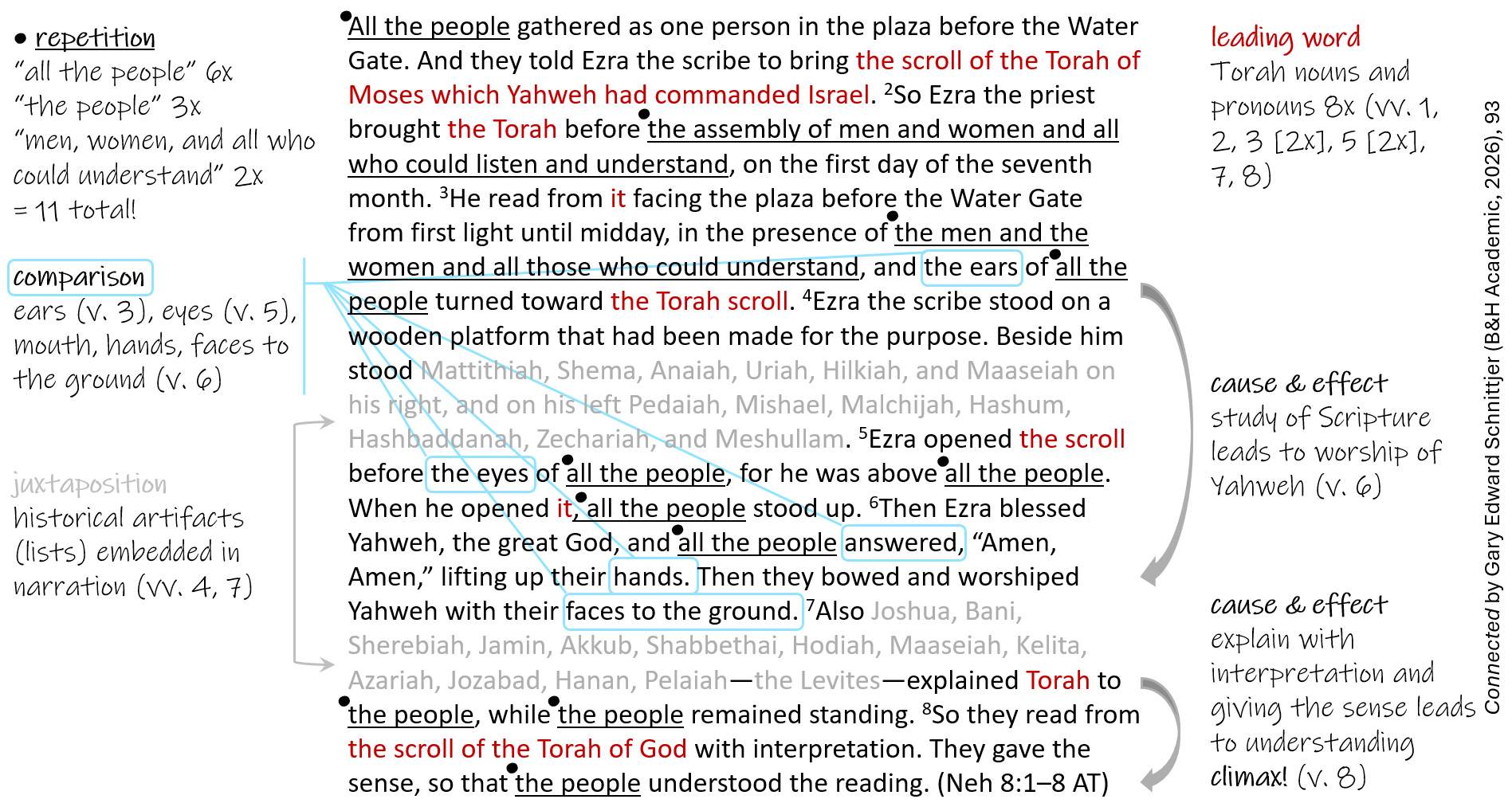
Connected evaluates these contextual connections and shows how they work. But a study like this also requires us to pause and observe the historical connections that the Bible emphasizes. Notice all of the historical signals that show the self-awareness of the narrator of this momentous event—when, where, who, what.
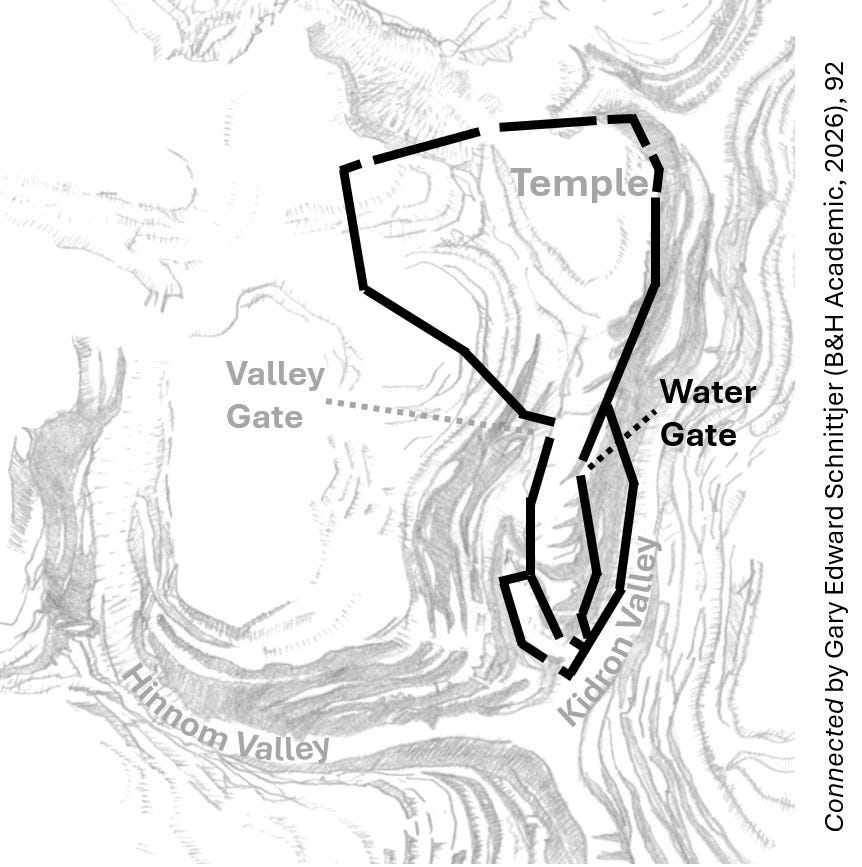
When the seventh month arrived, and the Israelites were in their towns, all the people gathered as one person in the plaza before the Water Gate. And they told Ezra the scribe to bring the scroll of the Torah of Moses which Yahweh had commanded Israel. (Neh 8:1 translation mine)
Think about the details. The Water Gate reinforces the people-centered drive to study the Bible. It is not Ezra’s idea. It does not take place at the temple. It takes place in a public space: at the Water Gate. It’s the people’s idea and Ezra does their bidding.
All of this serves as a guide for us to study the Bible according to what the Bible teaches about studying the Bible.
Want more?
Take a look at chapter 4 “Welcome to Studying the Bible” for a detailed evaluation of this exciting Bible study right from Nehemiah 8.

Coming up
Next month: How I changed my mind about Ezra-Nehemiah. And watch your in-box for podcast interviews coming out in the next weeks.
Cairn University
Walk a different path. Prioritize Christ and his word.
